
 Search Articles


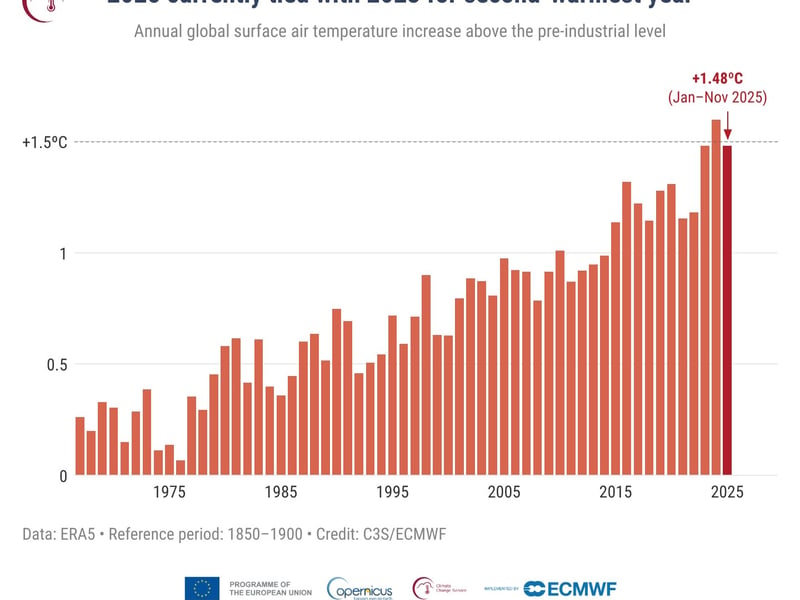
(CN) — This year is on track to become the second-warmest on record globally, according to an update released Tuesday by the European Union’s climate agency.
Critically, the Copernicus Climate Change Service report highlighted how the planet’s temperature also is set to exceed the Paris Agreement threshold over a three-year timeframe, an ominous sign of accelerating global warming.
As of November, this year’s average global temperature was tied with 2023 as the second-warmest year on record, the agency said. Last year was the hottest ever measured with an El Niño weather cycle and other factors heating up a planet already under stress from greenhouse gases.
In signing the 2015 Paris Agreement, world governments agreed to reduce carbon emissions to keep the planet from reaching a state where it is 1.5 degrees Celsius, or 2.7 degrees Fahrenheit, warmer than the pre-industrial age year after year. Many scientists warn the Paris Agreement goal is increasingly unreachable due to the continuing rise in both temperatures and carbon emissions.
Between January and November, the planet’s average temperature this year was 1.08 degrees Fahrenheit above the 1991-2020 average, a benchmark climate scientists use to calculate warming trends.
When compared to the planet’s climate before the onset of industrialization and the mass burning of fossil fuels in the mid-1800s, this year’s average temperature was 2.6 degrees Fahrenheit warmer than the pre-industrial age.
“The three-year average for 2023–2025 is on track to exceed 1.5 degrees Celsius for the first time,” said Samantha Burgess, a lead climate scientist at Copernicus, in a statement. “These milestones are not abstract — they reflect the accelerating pace of climate change and the only way to mitigate future rising temperatures is to rapidly reduce greenhouse gas emissions.”
According to the latest analysis by the Global Carbon Project, global carbon emissions from fossil fuels are projected to rise 1.1% in 2025, a record-high increase.
The continuing rise in emissions reflects the reality that global economic growth remains tightly linked to fossil fuels. Since 1990, global gross domestic product has nearly doubled, while carbon emissions have increased by roughly two-thirds, according to a November report by the United Nations Trade and Development.
The warming documented by Copernicus appears to not be a passing anomaly, but a result of persistent, cumulative emissions that continue to outpace mitigation efforts.
Worryingly, progress on global climate mitigation has stalled. In a November report, the UN’s Environment Programme found governments lagging in efforts to rein in fossil fuels.
“Nations remain far from meeting the Paris Agreement goal to limit warming to well-below 2 degrees Celsius, while pursuing efforts to stay below 1.5 degrees Celsius,” the UNEP report said.
The agency said global annual emissions would need to shrink between 35% and 55% by 2035 (compared with 2019) to get the planet on a pathway to staying under the warming threshold.
Indeed, there are reasons for deep concern over how global warming can be contained in a context of growing geopolitical tensions and economic rivalry between the world’s superpowers.
Making matters worse, U.S. President Donald Trump has withdrawn the United States from the Paris Agreement and his administration dismisses the science behind global warming.
In this chaotic moment, many governments now view fossil fuel resources, energy security and industrial competitiveness as key to their survival — leading many to prioritize economic growth and resource control over emissions reductions.
Even the EU, a longstanding climate policy leader, has begun to scale back its Green Deal policies, a repositioning that risks further weakening of global action against climate change.
Courthouse News reporter Cain Burdeau is based in the European Union.
 Follow @cainburdeau
Subscribe to our free newsletters
Our weekly newsletter Closing Arguments offers the latest about ongoing trials, major litigation and rulings in courthouses around the U.S. and the world, while the monthly Under the Lights dishes the legal dirt from Hollywood, sports, Big Tech and the arts.